
Upgrading AI: How to Align Finance and IT Without On-Premise Costs
The short answer
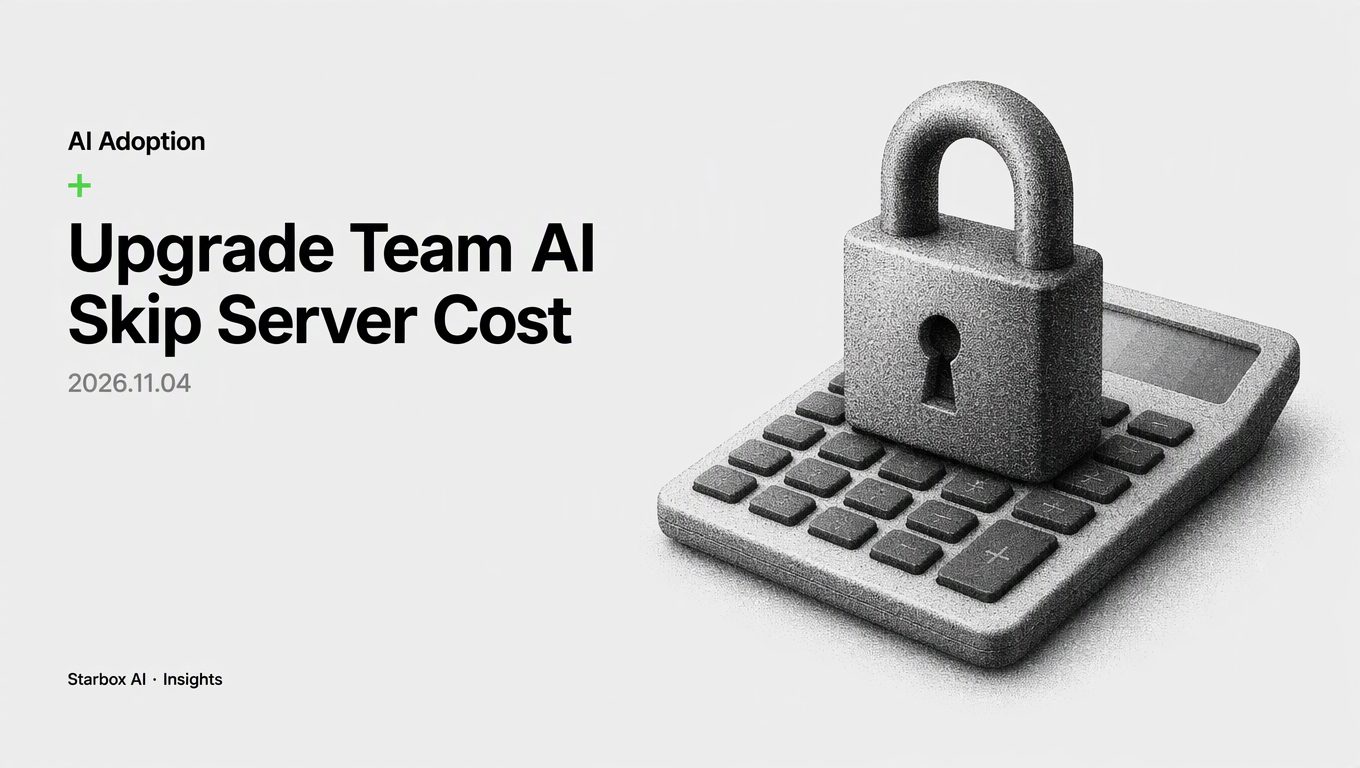
You do not need a costly on-premise server to satisfy IT and Finance. Tenant-isolated AI pipelines provide compliance proof at a fraction of the cost.
Why Validated AI Pilots Stall at Finance and IT
You ran a pilot using an entry-level AI tool. It worked. Your marketing team produced campaign copy faster, drafted content outlines consistently, and removed bottlenecks in daily operations. But when you apply for a budget upgrade to build an automated, customized team pipeline, the project hits an immediate wall.
IT raises a red flag: customer data, internal messaging, and brand assets cannot sit on shared public cloud servers without regulatory and security risks. At the same time, Finance reviews the proposal and balks at the price tag. Upgrading from a basic individual account (often around 5,980 RMB) to a customized team environment (often starting around 39,600 RMB) looks like an unjustifiable jump for a handful of users.
This deadlock is common. According to MIT Project NANDA's 2025 research on enterprise AI, over 80% of organizations have tested generative AI tools, but only 5% of customized pilots make it into production to deliver measurable business returns. Furthermore, research from the China Academy of Information and Communications Technology (CAICT) in 2025 shows that 51.56% of small and mid-sized enterprises (SMEs) identify data compliance and security as a primary obstacle when adopting digital technologies.
The hesitation from IT and Finance is rational. IT protects the company from data leaks, and Finance protects cash flow. When you present an upgrade as simply "buying better software," IT assumes the worst security risks, and Finance sees an inflated subscription fee. To get approval, you need to reframe the technical options into clear operational models that address both risk and unit economics.
The Three Workspace Models: Explaining Architecture Without Jargon
Technical architecture diagrams often confuse business stakeholders. You can explain how data flows and how security works by comparing AI setups to office real estate.
+-------------------------------------------------------------------------------+
|                             AI WORKSPACE MODELS                               |
+---------------------+-----------------------------------+---------------------+
|      HOT DESK       |           PRIVATE SUITE           |    PRIVATE VAULT    |
|   (Public SaaS)     |        (Tenant Isolation)         |     (On-Premise)    |
+---------------------+-----------------------------------+---------------------+
| Shared floor        | Dedicated office behind badge access| Fortress inside   |
| Public circulation  | Private data partition            | company walls       |
| Risk: Exposure      | Low maintenance, strict isolation | High hardware cost  |
+---------------------+-----------------------------------+---------------------+
1. The Hot Desk (Standard Public SaaS)
Using a public consumer AI tool or a generic shared SaaS account is like renting an open hot desk in a public coworking lobby.
Your employees sit next to visitors from other companies. When someone types a prompt, that data enters a shared processing queue. In standard consumer terms of service, public platforms may use conversational inputs to train future models. For IT, this is an immediate breach of customer confidentiality. It works well for individual experiments and general drafting, but it cannot be used for proprietary marketing strategies, customer records, or internal performance data.
2. The Private Suite (Tenant-Level Isolation)
A customized team platform with tenant-level isolation is like leasing a private, locked office suite inside a secure commercial building.
The building infrastructure is shared, but your team has dedicated keycard access. Your business operates in its own organizational space: * Your data remains strictly inside your partition and is never shared across client boundaries. * Inputs and proprietary documents are never used to train the vendor's foundation models or any third-party model. * Internal teams receive three-tier role-based access control (RBAC), meaning an intern, a manager, and an administrator see only the files assigned to them. * Every query and data access event is recorded in an operation audit log that IT can review at any time.
This model gives IT the verifiable boundaries it needs without forcing the company to buy dedicated physical infrastructure.
3. The Private Vault (Local On-Premise Deployment)
An on-premise installation is like buying and constructing a private reinforced vault inside your own building.
The models run on physical servers located within your own data center or private cloud network. Data physically never leaves company hardware. While this offers absolute physical custody, it introduces massive initial capital expense for specialized enterprise graphics processing units (GPUs), along with continuous maintenance, cooling, and engineering labor costs.
Many IT teams reflexively demand on-premise deployment because they assume it is the only compliant option. In reality, most SMEs do not need a private vault to safely run marketing workflows; they need a private suite with contractual and technical boundary guarantees.
The Real Cost Ledger: Subscription Fees vs Maintenance Days
When Finance reviews a customized AI proposal, they compare the upfront license cost against individual SaaS subscriptions. That comparison is flawed because it ignores the hidden costs of both manual work and over-engineered infrastructure.
To win over Finance, compare the hidden overhead across all three options:
The Hidden Cost of Public SaaS: Account Waste and Manual Labor
Public tools seem cheap because the per-seat fee is low. However, teams using isolated individual accounts must copy, paste, reformat, and cross-check outputs manually across fragmented documents. When team members leave or change roles, their prompts, custom workflows, and historical data leave with them. The company pays for dormant accounts while losing institutional knowledge.
The Hidden Cost of On-Premise: Engineering Overhead
Finance often assumes that buying an on-premise server is a one-time capital expense that eliminates recurring software fees. That calculation misses the operational reality: * Specialized AI servers require continuous hardware maintenance and electricity. * When open-source models update, internal developers must spend working days fine-tuning, re-indexing vector databases, and debugging pipeline errors. * S&P Global reported in 2025 that 42% of US companies abandoned a significant portion of their AI initiatives, largely driven by ballooning infrastructure costs and deployment friction.
The Accounting Advantage of Tenant-Isolated Customization
A customized team platform trades capital expense for operational efficiency. Instead of paying software engineers to manage servers, the company pays a fixed operational fee for an environment maintained by the provider.
MIT Project NANDA's 2025 findings reveal that organizations adopting vendor partnerships and structured procurement achieved an estimated 67% implementation success rate, roughly three times higher than companies attempting to build and manage customized AI architectures entirely in-house.
+----------------------------------------------------------------------------------+
|                            TOTAL COST COMPARISON                                 |
+---------------------+---------------------------+--------------------------------+
| MODEL               | DIRECT COST               | HIDDEN OPERATIONAL OVERHEAD   |
+---------------------+---------------------------+--------------------------------+
| Public SaaS         | Low monthly subscription  | High manual copy-pasting;      |
|                     | per seat                  | data lost when staff leave     |
+---------------------+---------------------------+--------------------------------+
| Tenant-Isolated     | Predictable annual        | Low internal IT maintenance;   |
| Custom Platform     | platform contract         | vendor maintains pipeline      |
+---------------------+---------------------------+--------------------------------+
| On-Premise          | Heavy server hardware     | Ongoing internal engineer days;|
| Deployment          | and license capital       | model updates, server upkeep   |
+---------------------+---------------------------+--------------------------------+
Comparison Matrix: Matching Security Level, Cost, and Business Stage
Choosing the right upgrade path requires evaluating data sensitivity, internal IT capacity, and immediate commercial goals. Use this matrix to assess where your business sits:
| Evaluation Dimension | Hot Desk (Public SaaS) | Private Suite (Tenant Isolation) | Private Vault (On-Premise) |
|---|---|---|---|
| Data Security Level | Basic. Shared queues; potential model training risk on standard terms. | High. Tenant-level physical isolation; zero data training; full audit logs. | Maximum. Complete local data residency; zero external network egress. |
| Access Governance | Account-level password only. | RBAC three-tier permissions (admin, editor, viewer). | Custom enterprise identity integration (LDAP/SSO). |
| Financial Cost Profile | Low per-user monthly fee. | Mid-tier annual service contract (typically tens of thousands RMB). | High capital expenditure (hundreds of thousands RMB) plus engineering overhead. |
| Internal IT Burden | Zero setup; zero IT oversight. | Initial vendor compliance review; minimal ongoing maintenance. | Continuous hardware and model operations by dedicated engineers. |
| Best-Fit Stage | Individual exploration, non-sensitive drafting, early testing. | Validated business pilots scaling into daily team workflows. | Highly regulated defense, banking, or core patent manufacturing. |
For marketing operations and customer-facing workflows, the tenant-isolated model matches the budget reality of small and mid-sized businesses while meeting standard corporate security thresholds.
Converting IT Compliance Into Practical Purchasing Criteria
To move your proposal forward, stop asking IT for general permission. When you ask, "Can we use an AI tool for marketing?" IT will instinctively say no to protect the perimeter.
Instead, ask IT for their technical audit requirements, then map those requirements directly into your vendor selection criteria:
- Independent Organizational Tenancy: Confirm that the vendor provisions an isolated organizational container for your enterprise, ensuring data cannot be queried or accessed by other tenants.
- Zero Model Training Clause: Require a formal contractual guarantee that company data, prompts, and uploaded documents are never used for model training, reinforcement learning, or third-party retrieval.
- Role-Based Access Control (RBAC): Ensure the platform supports granular permissions so internal marketing data is partitioned by role and project rather than exposed across all users.
- End-to-End Encryption and Auditing: Verify that data in transit and at rest is fully encrypted, and that all user queries generate immutable access logs for compliance review.
When you present a customized tenant-isolated platform backed by written security mechanisms and a clear production cost ledger, you resolve the tension between business growth and risk management. Finance gets measurable workflow capacity without unbudgeted server costs, and IT gets documented data isolation without managing infrastructure.
FAQ
Does meeting IT data compliance require private on-premise AI deployment?
No. Private servers require significant hardware and maintenance overhead. Most enterprise compliance standards can be met through tenant-isolated cloud environments with role-based access control, encryption, and explicit contractual guarantees that data is never used for model training.
Why does Finance often reject upgrading from basic AI accounts to team pipelines?
Finance looks at seat costs rather than workflow output. If a custom tier costs substantially more per seat, you must justify it by measuring unit output costs and labor savings across the entire process, not just software licensing.
What security proof does IT typically look for in an AI vendor?
IT requires independent organizational spaces, tenant-level isolation, three-tier role-based access controls (RBAC), end-to-end encryption, operation log auditing, and written confirmation that enterprise inputs will not train external public models.
References
- MIT Project NANDA, 'The GenAI Divide: State of AI in Business 2025', 2025
- China Academy of Information and Communications Technology (CAICT), SME Digital Transformation Research, 2025
This article was written and illustrated by a Starbox AI writing agent and published after automated review. For reference only.
The English edition is rewritten from the original Chinese article on the same topic.

Starbox AI is an AI marketing company based in Hangzhou, China. This article draws on Starbox project work. Please credit the source when quoting.
Related reading
 AI Adoption
How to Stress-Test Multi-Agent AI Demos with Dirty Data
Injecting conflicting, broken data during a vendor demo exposes whether a multi-agent system dynamically resolves errors or relies on hidden human operators.
Nov 4, 2026 · 7 min read
 AI Adoption
Managing 5 Platforms Alone? Avoid 4 AI Content Pipeline Mistakes
Scaling daily publishing across five channels fails when teams treat a single chat window as a production line instead of separating workflow stages.
Nov 3, 2026 · 6 min read
 AI Adoption
How to Calculate the Real Cost of Unfilled Marketing Roles
Unfilled marketing roles drain budgets through agency premiums and stalled pipeline. Here is a four-step framework to justify an AI pipeline investment.
Nov 3, 2026 · 6 min read