
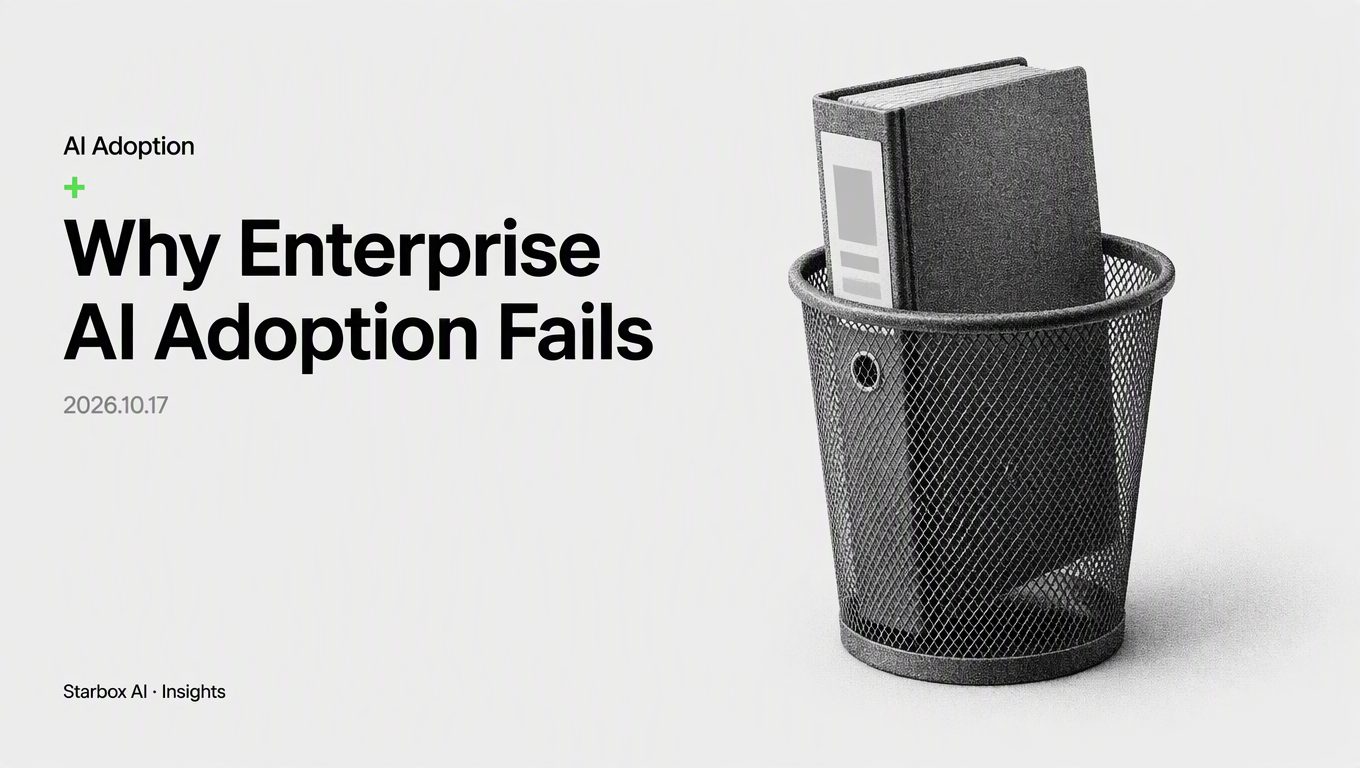
The 3 Most Common Ways Enterprise AI Adoption Fails
The short answer
Most enterprise AI rollouts fail through shelfware, shelf-strategy, or faded training. All three stem from the missing bridge between tools and daily workflow.
- Failure 1: Buying generic tools without embedding business SOPs into them
- Failure 2: Buying strategy reports with nobody capable of executing them
- Failure 3: Running one-off training with no ongoing usage tracking
Big investments, minimal returns
According to MIT NANDA's 2025 report The GenAI Divide, enterprises have invested $30 billion to $40 billion in generative AI, yet roughly 95% of organizations see no measurable return. In McKinsey's 2025 survey The state of AI, only about 6% of respondents qualify as "high performers" capturing significant value from AI.
Working with enterprise clients at Starbox AI, we see most failures fall into three patterns.
Failure 1: Buying tools nobody uses
A company buys AI seat licenses, hands them to employees, and checks back a month later only to find that almost no one touches them.
Generic tools do not understand your company's workflows. Employees have to invent prompts from scratch and feed context manually every time. Because the outputs vary wildly, people abandon the tool after a couple of tries and revert to their old habits.
How to avoid it: Turn your standard business procedures into pre-configured SKILLs and organize company assets into a structured knowledge base. Employees should only need to issue a single natural-language instruction.
Failure 2: Buying a strategy report that sits on a shelf
A company pays a consulting firm top dollar for an AI transformation roadmap. They receive a comprehensive slide deck, but no one can execute it.
The disconnect lies between strategy and execution. The strategists who authored the report are not responsible for implementation, and the internal team lacks the technical capability to build what was proposed.
How to avoid it: Choose partners who provide both the platform and hands-on deployment. Pay for operational results, not strategy decks.
Failure 3: Returning to the status quo three months after training
A company runs company-wide AI training sessions. Employees leave energized, but three months later, day-to-day operations have not changed at all.
Training creates awareness; it does not build daily habits. Without ongoing usage tracking and structured data reviews, adoption decays quickly.
How to avoid it: Appoint and train an internal AI operations lead responsible for driving daily utilization and running monthly review cycles.
The missing piece
All three failures point to the exact same operational gap: between generic AI tools and real business operations, someone must embed domain expertise into AI systems and stay involved until business results materialize.
This is the exact challenge the FDE (Forward Deployed Engineer) model solves. Starbox AI delivers FDE consulting across seven structured stages, starting with the marketing department. Learn more in What Is FDE On-Site Consulting?.
FAQ
Which department should lead enterprise AI adoption?
Start with marketing. Marketing teams feel execution bottlenecks most acutely, results are easily quantified, adoption barriers are low, and successful playbooks can be replicated across other departments.
How do you measure whether AI adoption is working?
Define baseline metrics before rollout—such as daily output per person, production time per asset, and AI visibility index—and track them month over month.
References
- MIT NANDA: The GenAI Divide: State of AI in Business 2025
- McKinsey: The state of AI 2025
The English edition is rewritten from the original Chinese article on the same topic.

Starbox AI is an AI marketing company based in Hangzhou, China. This article draws on Starbox project work. Please credit the source when quoting.
Related reading
 AI Adoption
How to Audit an AI Pipeline: Automated System or Human Patchwork?
Real enterprise AI pipelines rely on deterministic data contracts and automated circuit breakers, not covert human intervention behind vendor dashboards.
Oct 29, 2026 · 8 min read
 AI Adoption
Stuck Choosing an AI Vendor? Run This Live 4-Step Test
Evaluate AI vendors by testing them live on your messiest operational tasks, scoring real output rather than polished sales demos.
Oct 28, 2026 · 6 min read
 AI Adoption
How to Calculate ROI When Upgrading from Basic AI to Custom Pipelines
Calculate AI upgrade ROI by quantifying manual breakpoint labor and marginal lead gains rather than comparing standalone software features.
Oct 28, 2026 · 5 min read