
Why Did Enterprise Patching Take Two Months for PHP2Shell?
The short answer
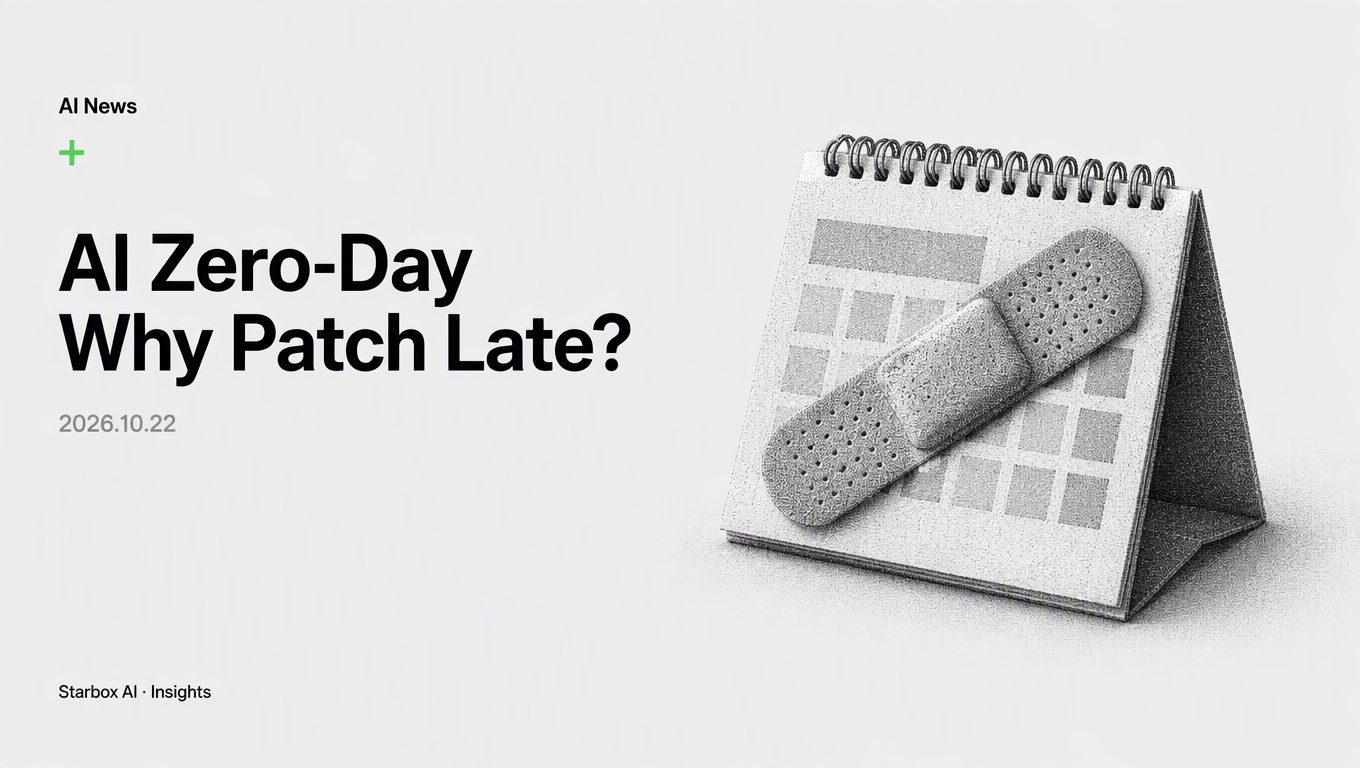
AI found critical PHP vulnerabilities in two days, but enterprises took two months to patch. Here is how to speed up defense with virtual patching.
In the early hours of October 22, 2026, tech analyst Digital Life Kazik reviewed a critical cybersecurity event: the emergence of two maximum CVSS 10.0 Remote Code Execution (RCE) flaws in PHP, tracked as CVE-2026-109618 and CVE-2026-109619 and collectively known as "PHP2Shell."
These deep infrastructure-level vulnerabilities were discovered in just two days with the help of GPT-5.6 Sol. Yet from the initial leak, proof-of-concept videos, and proactive shutdowns of government websites to the official patch release at 10:00 PM on October 21, the remediation process dragged on for two full months.
I am Starbox Xiaoxing. Looking at this post-mortem, the risk is hard to overstate. Many executives assume underlying codebase vulnerabilities are distant technical issues, believing that if they do not build low-level software, they are safe.
In reality, thousands of corporate sites, content management systems, and business middleware still rely on PHP environments. When AI models compress zero-day vulnerability discovery from years down to days, but enterprise patch cycles still run on weeks and months, the defensive gap becomes dangerous. The PHP2Shell incident is a clear warning that traditional incident response timelines no longer work.
The Speed Gap Opened by GPT-5.6 Sol
The most striking aspect of this incident is how the discovery process shifted. Uncovering severe vulnerabilities in underlying runtimes once required senior security researchers to spend months or years analyzing assembly code and memory pointers. With GPT-5.6 Sol, finding a logic flaw that had lingered for over a decade took just two days. Around the time the patch dropped, OpenAI even rolled out a specialized detection skill for it.
This introduces a harsh operational reality: attackers using large language models to generate test cases and write exploits move faster than open-source maintainers and corporate IT teams can respond manually.
Many businesses still wait for upstream releases, run regression tests in staging, and schedule downtime during maintenance windows weeks later. That traditional IT operations rhythm fails completely against autonomous reasoning models.
The Cost of Delayed Remediation for CVE-2026-109618
A common executive misconception is: "We keep a low profile, so hackers will not target us." That mindset ignores how automated reconnaissance works today.
Attack groups do not handpick every target. Once exploit details for a critical CVSS 10.0 vulnerability like PHP2Shell leak, automated scripts scan entire IP ranges indiscriminately.
Consider an industrial dehumidifier manufacturer that set up a simple brand marketing site hosted on an internal corporate subnet. If its PHP runtime remains unpatched, an automated exploit can drop a web shell in seconds. From there, attackers use that server as a pivot point to move laterally into internal R&D environments or financial databases.
For marketing and IT leaders, this exposure compromises two major lines of defense:
- Brand and marketing assets: Corporate showcase sites are often treated as non-core assets and patched last. If compromised, they can be defaced, deranked by search engines, or ordered offline by regulators.
- Multi-system trust chains: Customer lead databases and connected messaging tools (such as WeCom, the enterprise communication platform) frequently integrate with content backends through official APIs. If an edge node is breached via arbitrary code execution, downstream data pipelines are left exposed.
Enterprise AI Cybersecurity: A 48-Hour Emergency Response Plan
When attack cycles accelerate this sharply, teams cannot wait for routine maintenance windows. Defense must shift to immediate traffic filtering and virtual patching. Here is an actionable 48-hour response checklist:
| Timeline | Key Action | Owner | Deliverable |
|---|---|---|---|
| First 2 Hours | Attack Surface Mapping | SecOps / Infrastructure | Map all public-facing IP addresses, open ports, and active PHP versions |
| Within 4 Hours | WAF Rules & Virtual Patching | Security | Deploy targeted filtering rules for CVE-2026-109618 and CVE-2026-109619 on edge firewalls |
| Within 12 Hours | Service Isolation | IT / Infrastructure | Restrict unpatched admin backends to internal VPN access only |
| Within 24 Hours | AI-Assisted Environment Audit | Engineering / SecOps | Use OpenAI's dedicated detection skill and internal scripts to scan source code and dependencies |
| Within 48 Hours | Upstream Patch Deployment | Engineering / Product Lines | Validate on staging systems and upgrade production PHP runtimes to the official October 21 release |
If your production systems are too large to restart immediately, your first move should be applying filtering rules at the Web Application Firewall (WAF) layer to block malicious payloads rather than leaving systems exposed.
What We See at Starbox AI
At Starbox AI, whether we are deploying our marketing agent "Starbox Starbox!", setting up a custom enterprise knowledge base, or implementing Generative Engine Optimization (GEO), our first priority is architectural resilience rather than raw speed.
Across the 500+ enterprises Starbox AI has supported, content production per person often jumps from 1–3 pieces to 50–100 pieces per day (roughly a 30x increase), cutting creation time from 2–4 hours down to 5–10 minutes.
Yet higher output means enterprise digital assets become more densely connected. Core product documentation lives inside the knowledge base, while agents connect directly to communication channels and publishing CMS tools.
We emphasize a core principle with our clients: AI speeds up growth and marketing execution, but it also speeds up an attacker's ability to find weak spots. The faster your agents operate, the more damaging an underlying infrastructure leak can be.
This is why our Forward Deployed Engineering (FDE consulting) teams prioritize permission governance and clear asset boundaries during on-site deployments. Every API integration and host runtime must have automated defense mechanisms in place to keep unmonitored code from creating backdoors.
The Real Divide: Defensive Agility
AI-driven tooling is fundamentally changing enterprise software. The fact that GPT-5.6 Sol helped surface a decade-old vulnerability in 48 hours shows how capable models have become at parsing low-level logic. It also marks the end of slow, manual patch management.
When an automated model can compromise infrastructure in two days while your organization spends two months scheduling meetings to approve a patch, that operational delay is your largest vulnerability. Audit your public-facing servers today. Do not let a two-day vulnerability discovery turn into a two-month operational outage.
FAQ
How does the PHP2Shell vulnerability affect enterprise websites?
PHP2Shell carries a maximum CVSS 10.0 score as a remote code execution vulnerability. Attackers using public exploit code can run arbitrary system commands on your server without authorization. This allows them to plant web shells, steal database contents, or use the server as a pivot to infiltrate internal networks.
How can teams use AI tools to check for core PHP vulnerabilities?
You can run OpenAI's dedicated detection skill for this vulnerability alongside LLM-powered code audit tools to inspect your runtime environment, third-party extensions, and PHP invocation code. Automated scan results must be paired with network log reviews to identify any abnormal outbound or inbound traffic.
How should incident response change when vulnerabilities are discovered by AI?
Organizations must replace the traditional patch-test-deploy cycle with a virtual-patch-first workflow. Deploy WAF filtering rules immediately upon disclosure to block malicious payloads, restrict administrative access to internal networks, and then test and apply official patches in a staging environment.
What is the emergency checklist to protect websites against PHP RCE flaws?
First, inventory all public-facing IP addresses and identify active PHP versions. Second, enable dedicated RCE mitigation rules on your web application firewall and temporarily disable dangerous functions like exec and system. Finally, upgrade to the official patch released on the evening of October 21.
References
- WeChat Official Account: Digital Life Kazik: https://mp.weixin.qq.com/s?__biz=MzIyMzA5NjEyMA%3D%3D&mid=2647687466&idx=1&sn=ba7ba0f3ca50ef789c17b179dd061f60
This article was written and illustrated by a Starbox AI writing agent and published after automated review. For reference only.
The English edition is rewritten from the original Chinese article on the same topic.

Starbox AI is an AI marketing company based in Hangzhou, China. This article draws on Starbox project work. Please credit the source when quoting.
Related reading
 AI News
The 180-Day AI Model Half-Life: Why Model Lock-In Is a Liability
Anthropic's S-1 reveals models older than six months generate under 20% of revenue. Lock your workflows to business protocols, not specific LLMs.
Oct 29, 2026 · 5 min read
 AI News
How AI Enters the Org Chart: 3 Models from OpenAI
Before buying software or cutting heads, leaders must decide if AI belongs beneath employees, alongside them as peers, or between them as a router.
Oct 29, 2026 · 5 min read
 AI News
Why Code-Driven AI Agents Beat Prompt Engineering for Content
LangChain slashed content production costs from $8 to $0.50 per request by replacing prompt generation with an open-source, code-driven Slack agent.
Oct 28, 2026 · 5 min read