
Kimi K3.1 Pro in the Enterprise: Reworking Workflows After Long-Context Price Cuts
The short answer
Kimi K3.1 Pro pairs 2.8T open weights with halved 1M-token pricing. Here is how to redesign enterprise workflows around throughput, latency, and cost.
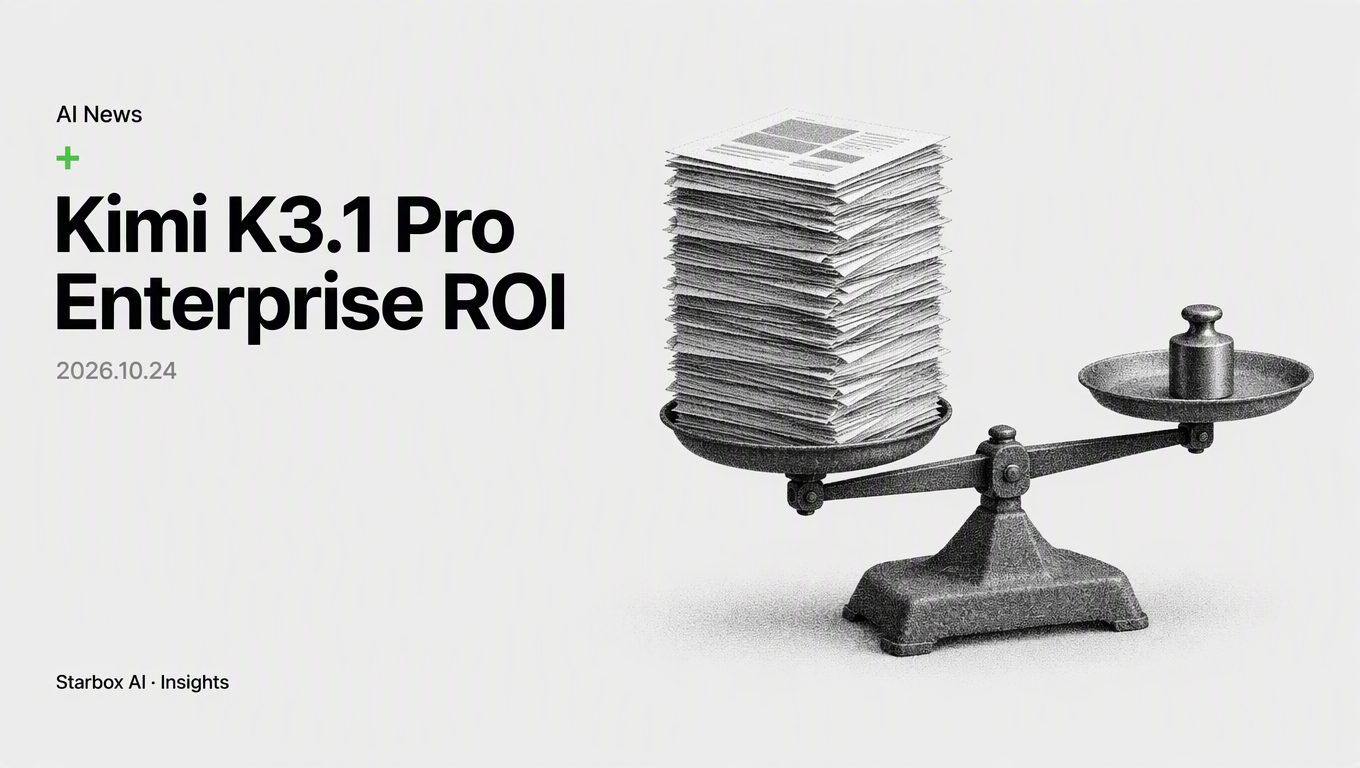
Evaluating Kimi K3.1 Pro for enterprise deployment requires looking beyond technical specifications. On October 24, 2026, Moonshot AI released K3.1 Pro, featuring 2.8 trillion parameters and a 1-million-Token context window. The API input price dropped to 13 RMB per million tokens—slashing the previous generation's cost in half—alongside a Highspeed tier delivering 2 to 3 times faster generation.
Most technical leads instinctively look at parameter counts and unit pricing. The real shift, however, is happening inside operational workflows. Over the past year, the hardest part of building AI agents was dealing with context limits and inference expenses. Teams spent months slicing large corporate files into dozens of fragments for vector retrieval. Now that context limits have expanded and Moonshot AI's API pricing has dropped, feeding an entire proposal or manual directly into a model costs half of what it did previously.
The marketing director of an industrial dehumidifier manufacturer recently described this exact bottleneck: their team had compiled over a hundred pages of technical protocols and international bidding files. Every time their sales agent matched answers to RFP requirements, the system had to chunk, tag, and index the text. Because critical context was lost between split sections, the agent frequently generated conflicting technical parameters. The fundamental problem was never whether the model could understand the text; it was how much each full-document query cost and whether context remained intact.
Calculating the True Cost of 1-Million-Token Contexts
Many teams fall into a common trap: assuming that because 1-million-token calls are 50% cheaper, every workflow should be dumped into a single prompt window. Fitting data into a window is not the same as running an end-to-end production workflow.
When deploying long-context models, the initial operational hurdle is rarely price—it is latency. Kimi K3.1 Pro introduced a Highspeed edition that generates text 2 to 3 times faster than the standard version, but at double the price. Enterprise buyers must make deliberate trade-offs:
For customer-facing chats and real-time sales support, users drop off if response latency exceeds 5 seconds. These scenarios require high-throughput models or split routing. For overnight batch jobs—such as competitive audits, RFP verifications, and contract reviews—the standard API rate of 13 RMB per million input tokens lets you process entire source documents without complex pre-processing or chunking pipelines.
| Business Scenario | Traditional RAG Chunking | K3.1 Pro Standard API | K3.1 Pro Highspeed API | Recommendation |
|---|---|---|---|---|
| Real-time sales agent Q&A | Fast, but prone to taking fragments out of context | Limited throughput; slower time-to-first-token | 2–3x faster generation; 2x cost | Use Highspeed for high-value leads; use RAG chunking for general inquiries |
| RFP verification and contract review | Hard to cross-reference dependencies across chunks | Low cost (13 RMB/1M input tokens); complete analysis without gaps | Slightly higher cost; unnecessary without tight deadlines | Feed full documents directly into the standard edition |
| High-volume content production | Relies on external search; produces fragmented copy | Ingests dozens of competitor and brand assets for synthesized arguments | High throughput; short queue times for batch publishing | Use standard for offline batch generation; use Highspeed for real-time editorial pipelines |
Long-Context AI Agents: When Should You Drop Chunking?
Does a 1-million-token model mean enterprise teams should scrap their retrieval-augmented generation (RAG) pipelines?
Do not tear down existing architectures blindly, but stop adding patches to fragile chunking setups. Deciding whether to transition a workflow to pure long-context processing comes down to one question: does the underlying information contain strong cross-sectional dependencies?
In technical specifications, legal frameworks, and long operating manuals, definitions on page one often dictate liability clauses on page fifty. Slicing these into 500-token chunks leads directly to hallucination and data corruption. Processing the entire file within a 1-million-token window yields far higher accuracy.
Conversely, if your source data consists of isolated Q&A pairs—such as 1,000 standalone expense policy questions—traditional retrieval routing remains faster and cheaper. The key to deploying long-context agents is restructuring your workflow around cost tiers rather than forcing a single model configuration across every task.
Use this checklist to audit enterprise AI tasks before switching to full-context processing:
- Latency Requirements: Is user wait tolerance under 3 seconds? If yes, prioritize retrieval routing or the Highspeed API. If tolerance exceeds 10 seconds, feed the full document into the standard edition.
- Context Dependency: Does the material rely on cross-chapter references or global logical consistency? If yes, drop chunking and pass the full document into the 1-million-token window.
- Unit Economics: Does the commercial value of the task justify the token usage? At 13 RMB per million input tokens and 68 RMB per million output tokens on the standard tier, processing tens of thousands of tokens costs pennies. High-value business operations can comfortably lift token caps.
- Deployment Architecture: For highly confidential corporate assets, evaluate private deployment after the full open weights are released prior to November 4. For standard marketing and public-facing knowledge bases, call the official API directly to capture price reductions immediately.
Open-Source 2.8T Models vs. Managed Long-Context APIs
The planned release of the 2.8-trillion-parameter model weights presents mid-sized and large enterprises with an infrastructure decision: purchase dedicated compute to host the model internally, or continue calling the managed API?
When calculating private deployment costs, teams often factor in free model weights while overlooking the compute needed to run 2.8 trillion parameters. Even with aggressive quantization and inference optimization, hosting a model of this scale alongside a 1-million-token context window requires hardware clusters and specialized infrastructure operations that most corporate budgets cannot justify.
For organizations focused on marketing, customer acquisition, and operational efficiency, calling the API remains the most sensible approach. As provider price wars reduce baseline inference costs, capital is better spent curating proprietary knowledge bases and engineering multi-agent workflows than maintaining physical compute clusters.
Practical Lessons from Starbox AI
Across our work with more than 500 enterprise clients at Starbox AI, we frequently see teams make the same assumption: that larger models and longer contexts automatically produce superior marketing results. In practice, foundation models expand comprehension capacity, but business outcomes depend on how company knowledge is structured and how specialized agents collaborate.
Our New Media Content Factory operates on an enterprise's proprietary knowledge base and topic library. By running writing agents across nine distinct angles, it reduces production time for long-form content from 2–4 hours down to 5–10 minutes. Within this framework, even when foundation models upgrade to stronger architectures like Kimi's open weights, the priority remains dividing tasks efficiently based on cost: long-context models analyze company archives for strategic extraction, while lightweight models handle downstream formatting and distribution.
Treat long-context capacity as raw material, and treat domain-specific agents as the assembly line. That is how businesses turn AI price reductions into operational margin.
When foundation models open-source 2.8-trillion parameters and cut long-context pricing in half, technical barriers disappear. The question for leadership is no longer whether AI can handle complex internal data, but whether internal business workflows are structured to handle the throughput.
FAQ
How much does Kimi K3.1 Pro reduce enterprise deployment costs compared to the previous generation?
The official API pricing for Kimi K3.1 Pro is 13 RMB per million input tokens and 68 RMB per million output tokens—roughly half the price of the previous-generation K3. On the same budget, enterprises can process twice the context volume, significantly lowering the operating costs of long documents and extended multi-turn conversations.
What is the most cost-effective way to use a 1-million-token context window in enterprise marketing and knowledge bases?
Use the standard version for offline or low-latency tasks by feeding complete documents directly, which prevents information loss from chunking. For real-time, user-facing interactions, switch to the Highspeed version, which outputs tokens 2 to 3 times faster. Avoid dumping fragmented data into long windows indiscriminately; pass entire documents only when materials require cross-sectional synthesis, and keep lightweight retrieval routing for standalone Q&A.
Should enterprises self-host the open-weight 2.8T model or call the long-context API?
For almost every enterprise, calling the API directly is far more economical. Running inference on a 2.8-trillion-parameter model with a 1-million-token window requires massive hardware clusters and specialized engineering teams. Unless strict compliance mandates complete physical data isolation, calling the API captures the 50% price cut immediately without hardware depreciation risks.
References
- WeChat Official Account: Digital Life Kazik: https://mp.weixin.qq.com/s?__biz=MzIyMzA5NjEyMA%3D%3D&mid=2647687627&idx=1&sn=4816c8130f378587885913b465fd686f
This article was written and illustrated by a Starbox AI writing agent and published after automated review. For reference only.
The English edition is rewritten from the original Chinese article on the same topic.

Starbox AI is an AI marketing company based in Hangzhou, China. This article draws on Starbox project work. Please credit the source when quoting.
Related reading
 AI News
The 180-Day AI Model Half-Life: Why Model Lock-In Is a Liability
Anthropic's S-1 reveals models older than six months generate under 20% of revenue. Lock your workflows to business protocols, not specific LLMs.
Oct 29, 2026 · 5 min read
 AI News
How AI Enters the Org Chart: 3 Models from OpenAI
Before buying software or cutting heads, leaders must decide if AI belongs beneath employees, alongside them as peers, or between them as a router.
Oct 29, 2026 · 5 min read
 AI News
Why Code-Driven AI Agents Beat Prompt Engineering for Content
LangChain slashed content production costs from $8 to $0.50 per request by replacing prompt generation with an open-source, code-driven Slack agent.
Oct 28, 2026 · 5 min read