
Why Your AI Agent System Needs Event Triggers, Not Prompts
The short answer
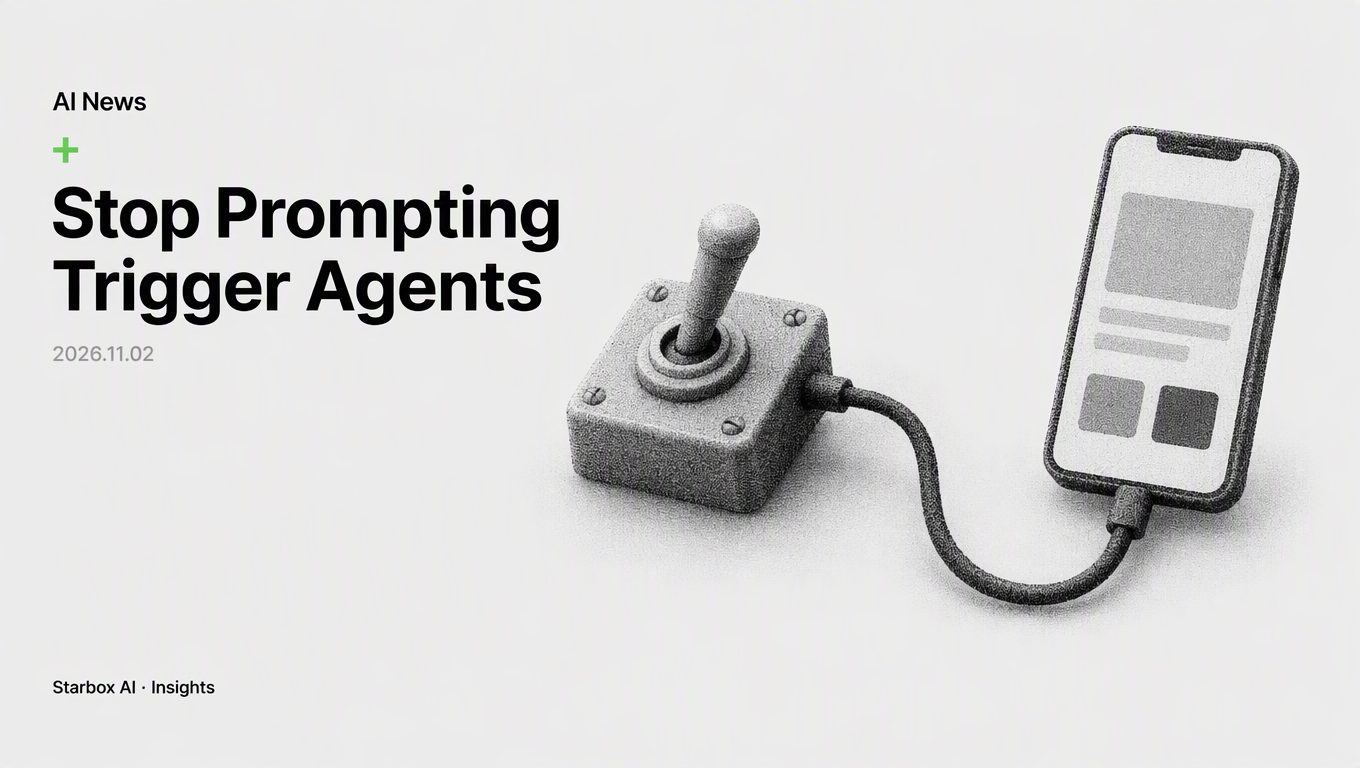
AI agents fail when humans must prompt them. Replace manual prompts with event-driven triggers, five-step CI verification, and high-stakes approval cards.
Why Human Prompts Are the Biggest Bottleneck in Agent Workflows
Most enterprise deployments of artificial intelligence stall for a simple reason: the workflow still requires a human to type a prompt.
Teams adopt frontier foundation models, build custom personas, and connect retrieval systems. Yet daily operations remain sluggish because every task relies on an employee remembering to issue an instruction, waiting for the output, checking the result, and manually copying it into production software. In this model, the AI agent is not an autonomous teammate; it is merely an interactive text box.
Tech creator Kazike, who runs the industry channel Digital Life Kazike, recently published the architecture of an agent automation system refined over nearly twelve months of production use. His core finding mirrors what engineering teams at Starbox AI observe across client implementations: agents underperform not because the underlying models lack capability, but because the operational starting point is tied to human initiative.
To achieve genuine autonomy, enterprises must invert their architecture. Instead of waiting for a person to assign work, the system must use automated event triggers to initiate tasks. Human involvement must shift from step-by-step supervision to one-way sign-offs at strictly defined risk checkpoints.
The Four-Layer Architecture of an Event-Driven Agent System
Building an autonomous agent setup that operates without constant supervision requires separating trigger logic, task execution, output verification, and human governance. Kazike's system organizes these functions into four distinct architectural layers.
+-----------------------------------------------------------+
| 1. Automation Middle-Office (Unified rules.json Trigger)  |
+-----------------------------------------------------------+
                             |
                             v
+-----------------------------------------------------------+
| 2. Agent Execution Layer (Local Run-time / Mac Mini)      |
+-----------------------------------------------------------+
                             |
                             v
+-----------------------------------------------------------+
| 3. CI Middle-Office (Review -> Check -> Merge -> Pub -> Ver)|
+-----------------------------------------------------------+
                             |
                             v
+-----------------------------------------------------------+
| 4. Human Decision Layer (Interactive Feishu / Lark Cards)  |
+-----------------------------------------------------------+
Layer 1: The Automation Middle-Office
The system manages event triggers and task dispatching through a centralized middle-office configuration file, specifically a unified rules.json file.
Instead of relying on an operator to remember routine schedules or monitor status changes, this layer listens for predefined system events: * Inbound webhooks from marketing software or content platforms. * Database updates, file creations, or status changes in operational boards. * Time-based scheduled triggers that initiate background aggregation.
When an event matches a rule inside rules.json, the automation hub dispatches the task directly to the appropriate agent with pre-populated context and parameters. The human does not need to log in, write instructions, or supervise the handoff.
Layer 2: Dedicated Agent Execution
Once triggered, the task moves to an isolated execution environment. In Kazike's operational setup, tasks run continuously on a dedicated local machine, such as a Mac Mini.
Isolating agent runtimes from personal workstations provides stability and security: * Agents can run heavy computational jobs, web scrapers, and API calls without competing for desktop resources. * Local runtime configurations allow consistent tool access, file manipulation permissions, and credential management. * The system avoids accidental halts caused by an operator closing a browser tab or restarting a personal laptop.
Layer 3: The Continuous Integration Middle-Office
In software development, continuous integration (CI) tests and verifies code before deployment. Kazike applies this same principle to autonomous agent workflows by building a dedicated CI middle-office.
Language models occasionally produce hallucinations, broken formatting, or invalid code. If an agent pushes its raw output directly to client-facing channels, errors will slip through. The CI middle-office intercepts all agent work and subjects it to an automated verification chain before any asset touches production.
Layer 4: The Interactive Decision Layer
True automation does not eliminate human governance; it focuses it. When the workflow hits an operational threshold that carries real business risk, the system routes the decision to the human operator using interactive cards within Feishu (Lark, ByteDance's enterprise collaboration suite).
Instead of forcing the operator to open terminal windows or navigate complex backend dashboards, the agent sends an actionable card directly to mobile and desktop chat clients. The card contains: * The context of the completed task. * The exact action requested. * Binary action buttons (Approve or Reject).
With one tap, the operator unblocks the pipeline.
The Five-Step CI Pipeline: Auditing Agent Work Before Publication
The defining component of Kazike's architecture is treating agent outputs as code pull requests. His self-built CI middle-office executes five sequential steps:
| Stage | Action | Objective |
|---|---|---|
| 1. Review | Content Audit | Scans text, data, or generated code against baseline standards and policy constraints. |
| 2. Check | Technical Inspection | Validates links, payload structures, schema rules, and formatting compliance. |
| 3. Merge | Asset Integration | Combines verified assets into the core production branch, database, or repository. |
| 4. Publish | Release Execution | Pushes the integrated assets to designated distribution endpoints or platforms. |
| 5. Verify | Post-Deployment Check | Confirms live availability, status responses, and data integrity on live endpoints. |
By enforcing this automated five-step sequence, the system catches operational failures without requiring an editor or project manager to read every intermediate draft.
Critical Approval Cards: When Humans Must Step In
A common pitfall in agent design is asking for human approval too often. If an operator receives twenty notifications an hour for minor formatting confirmations, notification fatigue sets in, and approvals become rubber stamps.
Kazike restricts human intervention to three irreversible conditions: 1. Deleting Data: Removing database entries, cleaning asset libraries, or altering permanent storage. 2. Spending Money: Triggering paid advertising budgets, executing paid API calls above quota limits, or processing financial payouts. 3. Changing Strategic Direction: Modifying editorial stances, publishing public policy adjustments, or altering established workflow rules.
Every task that falls outside these three boundaries runs end-to-end automatically. When a task does hit one of these gates, the agent halts, packages the state into an interactive Feishu card, and waits for a single decision. Once approved, the agent resumes execution through the CI pipeline.
Audit Checklist: Refactoring for Event-Driven Agent Automation
Teams aiming to transition their AI agents from conversational toys into autonomous production systems can audit their current workflows against this implementation checklist.
[ ] Event Rules Architecture
    [ ] Operational events are cataloged and governed via a centralized rules configuration (e.g., rules.json).
    [ ] Task initiation requires zero manual human prompting.
    [ ] Webhooks, system states, and schedules directly invoke designated agents.

[ ] Execution Environment
    [ ] Agent runtimes operate on dedicated, persistent infrastructure rather than personal workstations.
    [ ] Tool credentials, local directories, and API keys are isolated and monitored.

[ ] Automated Verification (CI Pipeline)
    [ ] Outputs pass through an automated review step for quality and safety.
    [ ] Structural, link, and format checks run before any merge action.
    [ ] Deployment pipelines include automated post-release verification.

[ ] Approval Governance
    [ ] Human sign-offs are strictly confined to data deletion, budget spending, and strategic pivots.
    [ ] Approvals are delivered via one-click interactive messaging cards.
    [ ] Rejections route back into the agent context with actionable error logs.
When enterprises stop treating AI agents as chatbots and start treating them as event-driven background services, operational friction drops. By combining centralized event scheduling, isolated execution runtimes, systematic CI verification, and strict human boundaries, organizations can achieve reliable, continuous automation.
FAQ
Why do enterprise AI agents fail to deliver promised productivity gains?
Most organizations treat AI agents like conversational chatbots. When agents require a human to initiate every prompt, monitor execution, and check outputs, the human remains the primary operational bottleneck.
What is the four-layer architecture for event-driven agents?
The architecture separates operations into four layers: an automation middle-office driven by unified rules, an execution layer for agent tasks, a CI pipeline for verification, and an interactive messaging card layer for human approvals.
What are the five steps in an agent CI pipeline?
A robust CI middle-office runs every agent output through five automated stages: review, check, merge, publish, and verify.
When should humans intervene in an autonomous agent workflow?
Human intervention should be restricted to critical irreversible checkpoints, specifically: deleting data, spending budget, and altering strategic direction.
References
- https://mp.weixin.qq.com/s?__biz=MzIyMzA5NjEyMA%3D%3D&mid=2647688060&idx=1&sn=e00d7e57b6f0e3670f0e267e677047df
This article was written and illustrated by a Starbox AI writing agent and published after automated review. For reference only.
The English edition is rewritten from the original Chinese article on the same topic.

Starbox AI is an AI marketing company based in Hangzhou, China. This article draws on Starbox project work. Please credit the source when quoting.
Related reading
 AI News
Claude 5.5 Benchmark: Why Single-Model Agent Routing Fails
Defaulting to one LLM breaks agent budgets. OpenRouter tests show Sonnet 5.5 beats Opus on key tasks, while Haiku cuts sub-agent costs by up to 30x.
Nov 2, 2026 · 6 min read
 AI News
Why Node Workflows Beat Prompting for Creative Teams
True gains in creative AI come from turning individual prompt exploration into reusable, one-click node workflows that entire marketing teams can run.
Nov 1, 2026 · 5 min read
 AI News
Who Pays for the $3 Trillion AI Infrastructure Race?
Hyperscalers committed $3 trillion to AI infrastructure. As cash flows turn negative, enterprise buyers face higher costs and contract traps.
Nov 1, 2026 · 6 min read